
When a prospective client contacts a law firm, the clock starts. Not on the legal matter. On the trust. Every hour between 'I submitted my information' and 'someone called me back' is an hour where that client is still looking at the next firm in the search results.
Most law firms handle intake the same way: a contact form, a voicemail box, a paralegal who gets to it between other tasks. The intake process works. It just doesn't scale, it doesn't run on nights and weekends, and it loses leads in the gaps between steps.
We built a fully automated intake pipeline for a South Florida law firm in 3 days. Not 3 weeks. 3 days. This post walks through what we built, why it works, and what the firm looked like before and after.
Before: A Paralegal, a Spreadsheet, and a Lot of Tabs
Before the automation, intake at this firm looked like most small law firm intakes: a form on the website that fired an email notification. A paralegal reviewed the email, checked the practice area, looked up the client's name in the CRM to see if they were already a contact, and manually created a new record if they weren't. Then she sent a templated email that lived in a Word document on the shared drive. Then she created a task in the case management system. Then she told the responsible attorney.
Five manual steps. Each one depending on the paralegal not being in a deposition, at lunch, or managing three other things at once.
The average response time was one to four hours during business hours, and 24+ hours on weekends. A lead that came in Friday evening after 5:00 wouldn't hear back until Monday after 9:00 a.m.
That gap matters more than it looks. Research on lead response shows that replying within five minutes can lift conversion by more than 20x compared to replying after thirty. Even a single hour of delay quietly costs you leads. Two days later, on a Monday morning, most of them are already gone, or already talking to the firm that answered first.

After: 3 Automated Steps That Run While Everyone Is Asleep
The automation replaced every manual step without removing any human judgment from the actual legal work.
Here's what happens now when a prospective client submits a form:
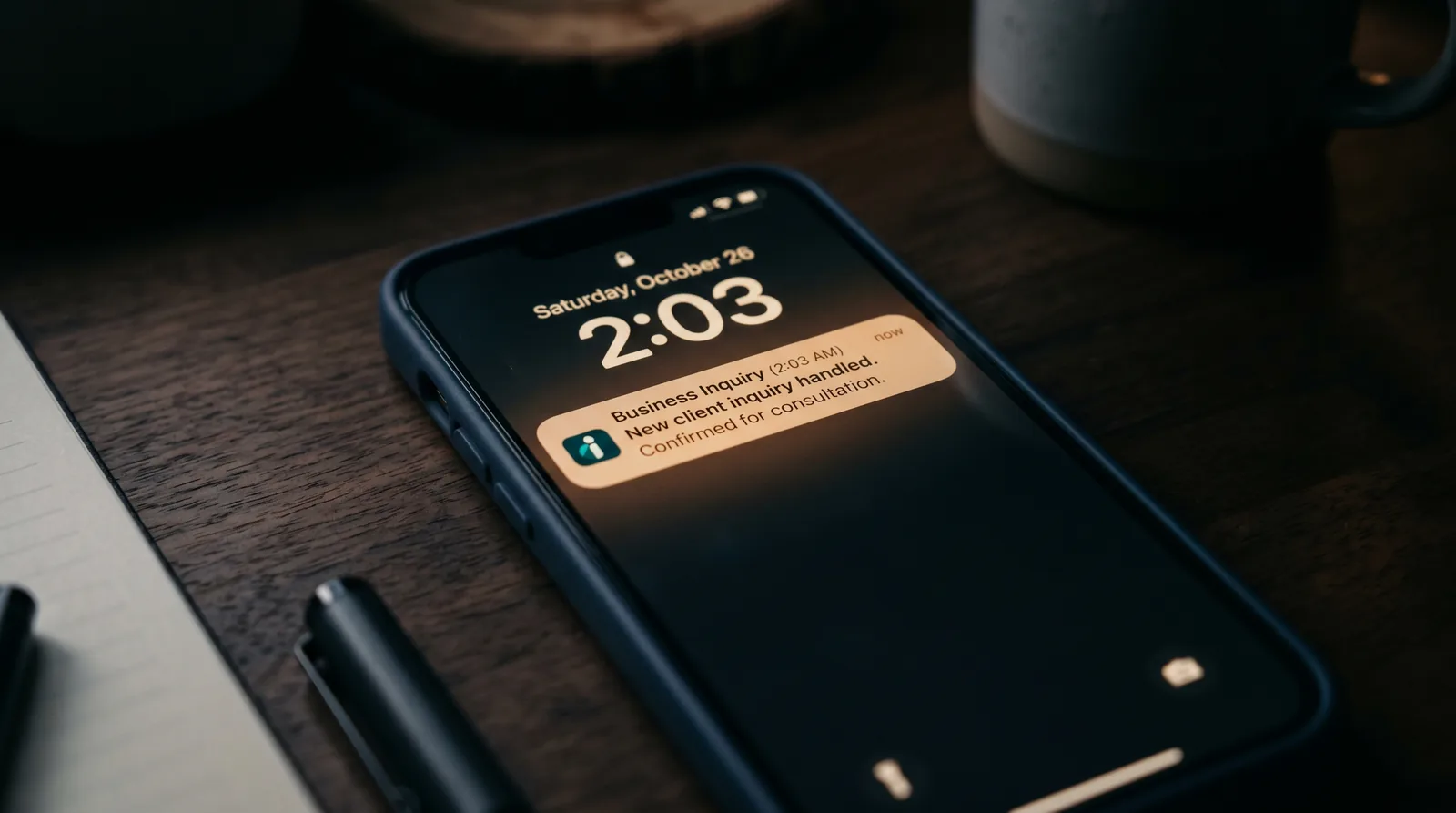
Step 1: The instant reply, 0 to 60 seconds. The moment a prospective client submits the intake form, the automation fires. Within 60 seconds they receive an email that references their specific matter, confirms the firm has it, sets expectations for what happens next, and includes a link to book a consultation. It runs at 2 AM on a Tuesday exactly the way it runs at 10 AM on a Saturday. The lead never sits.
Step 2: The record builds itself, and someone owns the follow-up. The form captures the practice area, the matter type, a short description, and the client's contact details, and the automation routes all of it straight into the CRM. If the contact already exists, the record is updated with the new matter. If they're new, a full record is created. No re-keying, no duplicates. If the client books a call through the booking app, it is assigned to the right paralegal automatically. If they don't, they get a reminder to book, and the paralegal is alerted with a task to reach out, a summary of the matter, and a link straight to the CRM record. Nothing falls through the cracks between "interested" and "booked."
Step 3: The handoff to the attorney. Once the paralegal has that initial intro call, the recording is saved into the CRM and the matter is routed to the appropriate attorney. By the time an attorney picks it up, the full context is already there. No re-explaining, no hunting for notes.
Total time from form submission to the client's first reply: under 60 seconds.
Why It Took 3 Days, Not 3 Weeks
Three days is fast. It's what happens when the process is mapped before anything is built.
Day 1 was discovery. Not 'discovery' as a sales meeting. Discovery as in: we sat with the paralegal, the office manager, and one of the attorneys and mapped exactly what happened between 'form submitted' and 'attorney ready to make first contact.' We diagrammed every step, every decision point, every exception. We found 4 intake paths and agreed on routing logic for each.
Day 2 was the build. The intake form was already live. The CRM was already running. The case management system had an API. The pieces existed. They just weren't connected. We built the workflow in n8n, tested each path with sample submissions, and documented the exception handling.
Day 3 was testing and handoff. We ran 20+ test submissions across all four intake paths, caught two edge cases (a submission with no practice area selected; a contact who already existed in the CRM with a slightly different email format), and added handling for both. Then we trained the paralegal on what to expect.
The firm went live on Day 3. Taking real leads.
What the Automation Didn't Touch
This is the part of automation conversations that matters most to legal clients.
We didn't automate the consultation. That's still a human conversation between a client and an attorney.
We didn't automate the conflict check. That runs in the case management system according to the firm's existing protocol.
We didn't automate the fee agreement or engagement letter. Those still require attorney review and client signature.
What we automated was the connective tissue between 'someone asked for help' and 'someone is ready to help.' The admin layer. The data movement. The response that used to wait until someone had a free 10 minutes.
The attorneys' time went down on intake admin. Their availability to new clients went up. The paralegal's intake workload dropped by roughly 60%, and she redirected that time to active client matters.
(That reallocation of time is where the real ROI lives. It doesn't show up in the 'hours saved' column. It shows up in what those hours became.)
Signs Your Intake Process Is Costing You Clients
You don't need a law firm to have this problem. Any service business with a contact form and a manual intake step is running this same risk.
Ask these questions:
What is your average response time to a new inquiry? If it's measured in hours, you're losing to businesses measured in minutes.
Does your intake process work the same at 8 PM on a Friday as it does at 10 AM on Monday? If not, you have a gap.
Could your team describe every step of your intake process, in order, from memory? If the answer varies by person, the process isn't documented. It's in someone's head.
Is any step dependent on one specific person being available? That's a single point of failure.
One of those should prompt a conversation. All four means the intake process is actively losing clients right now.
Intake automation isn't a technology story. It's a business continuity story.
When a prospective client submits a form, they should hear back in minutes, not hours, regardless of what day of the week it is or how busy the team happens to be. That's not a high bar. It's the one that determines whether they hire you or the next firm in the search results.
If your intake process runs on a human's availability, it's worth a 30-minute conversation to map what the automated version looks like. Book a free discovery call. No commitments, just clarity.
The same intake pattern shows up anywhere a request has to survive a chain of handoffs. Here is the property management version.
Intake does not start at the form. It starts on the phone, usually after hours. Here is what it took to put a bilingual AI agent on a firm's line.