
A Coral Gables insurance agency with 20+ producers writes business with more than ten carriers. Each carrier changes its policy guidelines, premiums, and coverage exclusions on its own schedule, on average 2 to 5 times a month. No single person can hold the current rules for ten-plus carriers in their head. So nobody tried. They guessed, asked a colleague, or pulled up a portal mid-quote.
Worse, the changes never arrive the same way twice. One carrier emails a spreadsheet. Another sends a download link that fails half the time. A third makes you log into a portal and pull documents one at a time. You cannot remember which carrier delivers which way, so you end up keeping a spreadsheet just to track how to track them. It is death by a thousand logins.
The agency wasn't disorganized. It had a CRM, a quoting platform, and producers who knew their carriers well. What it didn't have was one place where the current rules across every carrier actually lived. The information existed. It was just scattered across ten-plus portals and inboxes, each in a different format, arriving through a different channel, and chasing every change down cost roughly 8 to 20 hours a month. This is what that cost, what producers got instead, and the path from one to the other.
carriers aggregated into one knowledge base
guideline changes per carrier each month
a month reclaimed from chasing changes
more policies under management in 60 days
Ten Carriers, Ten Ways to Hear About a Change
Start with how a single guideline change actually reaches the agency. There is no standard. One carrier emails a spreadsheet. Another posts an update and sends a download link that works maybe half the time. A third makes a producer log into a portal and pull three or four documents one at a time. The same change, from ten different carriers, arrives ten different ways.
Nobody can keep that straight from memory. So the agency did the only thing it could: it kept a spreadsheet to track how to track each carrier. A spreadsheet about spreadsheets. That is the quiet absurdity of it, and it is death by a thousand logins.
Then someone has to actually chase it all down. Open each carrier's channel, one at a time. Find what moved: updated underwriting guidelines, premium adjustments, new coverage exclusions. Pull it out of whatever format it came in. Reconcile ten-plus carriers' worth of changes into one document a producer could read. Across 10+ carriers changing 2 to 5 times a month, that ran 8 to 20 hours a month, and the work demanded enough judgment that it fell to a person instead of a system.
That was the visible cost. The expensive one was spread across the floor. A producer mid-quote needs a carrier's current rule for a specific coverage and cannot hold ten carriers' current rules in their head, because no one can. So they stop and dig through a portal, or interrupt a colleague who happens to be nearby, or quote from memory and hope it still holds. Every one of those moments is a delay. Some become missed opportunities, where a client gets a faster answer somewhere else. Some become errors, where a quote goes out built on a guideline that moved last week. We've mapped out what manual work actually costs your business elsewhere, and stale information is the line item nobody puts on the invoice.
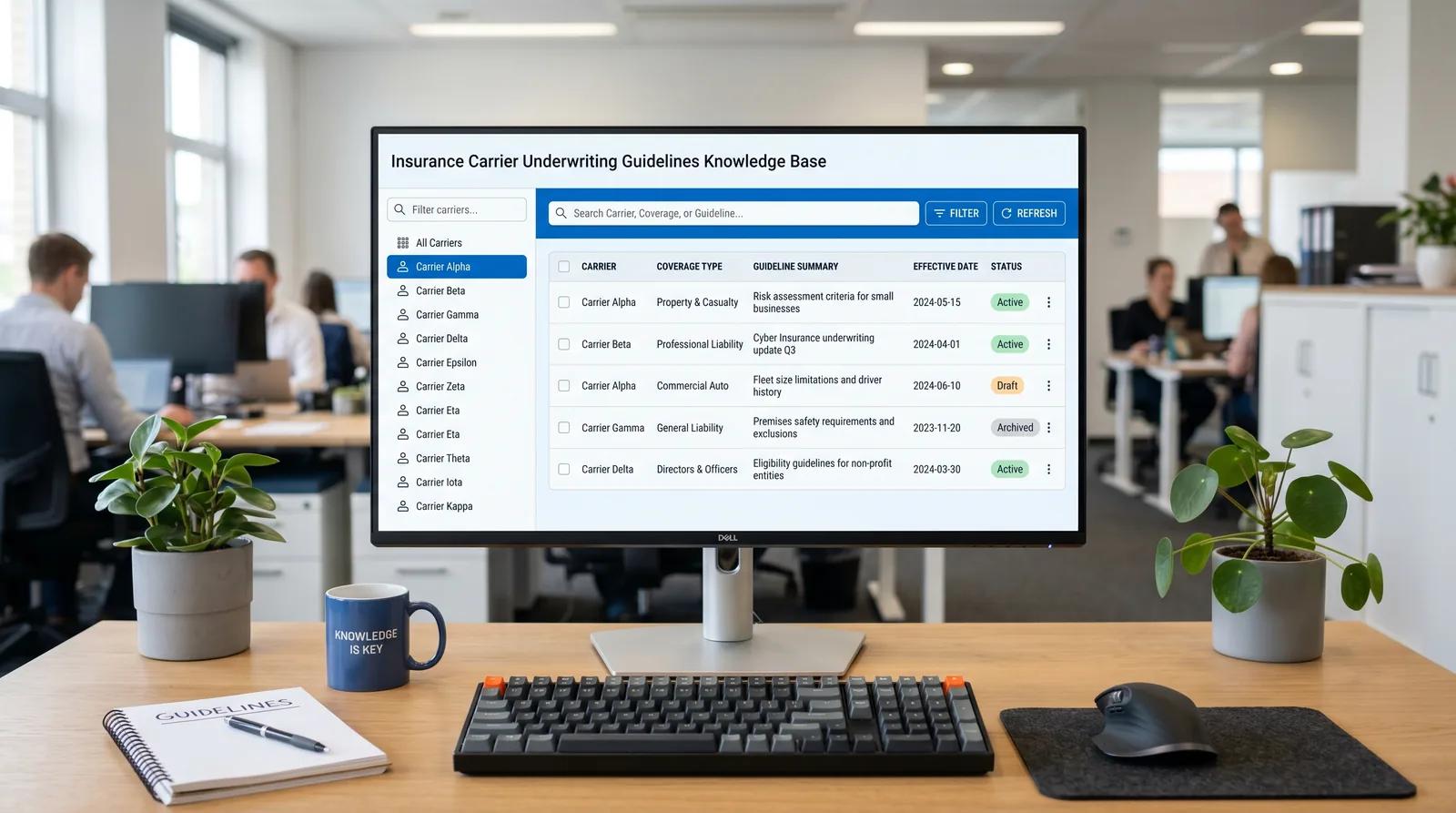
Producers Quote With Confidence
Now picture the same agency once that mess is gone.
A producer is mid-quote and needs a carrier's current rule for a specific coverage. They do not stop, dig, or guess. They ask in plain language, "what is this carrier's current guideline for this coverage," and the current answer comes back in seconds. The right rule for any of ten-plus carriers is one search away, no matter how that carrier happened to deliver its last change.
Nothing slips through. The information a producer quotes on is the live information, not a snapshot that quietly went stale last week. The interruptions stop. The re-quotes and corrected emails stop. The hours that used to disappear into chasing changes come back, and they go into client outreach instead. Within 60 days, policies under management were up 12%.
That is the version of the day worth wanting: producers quoting fast, quoting on current information, and trusting the answer in front of them. The next section is how the agency got there.
How We Built One Searchable Source of Truth
The path from the mess to that confident quote ran in four steps.
Discovery first. Before any build, we mapped how every carrier delivers and formats its updates: which ones email a spreadsheet, which send a link, which bury it in a portal, what a meaningful change looks like, and how it should read once it lands. Ten-plus carriers meant ten-plus channels and formats that had to map onto one consistent structure. We documented all of it, and that documentation became the spec. This is the step you cannot skip. You can't aggregate ten carriers into one source of truth until you've actually mapped what each one says and where it says it. Skip it and you build a knowledge base that is confidently wrong.
Then one central, searchable knowledge base. We built a single place that holds every carrier's current guidelines, premiums, and exclusions, and that automatically collects each change as it lands, in whatever format the carrier sends it. No one opens ten portals anymore. The base keeps itself current underneath.
Then producers query it on demand. Any of the 20+ producers asks it in plain language and gets the current answer in seconds, pulled from the live base. To keep everyone broadly oriented, a light digest of what changed lands in inboxes on Monday morning, a calm start to the week rather than a scramble. The changes do not arrive weekly. The digest just gives the team one steady place to glance.
Then the result. Producers stopped guessing and started asking the system. Map the messy inputs first, then automate. The order is not optional.

The Highest-ROI Workflows Are High-Frequency and Mid-Judgment
Chasing carrier changes wasn't an outlier. It was a type. The agency had others: the renewal letter sequence, the carrier portal data entry. Each one runs constantly, each one needs a little judgment, and each one quietly taxes growth.
That is the pattern worth looking for. The highest-ROI automation candidates are the workflows that are high-frequency and mid-judgment. Frequent enough that the hours add up. Just judgment-heavy enough that they got handed to a person instead of a system, and then stayed there.
Here's the test. Pick a task your team runs constantly. Ask: what triggers it, what information moves and from where, and what would it look like if the system handled the rote part and left the judgment to a human? If you can answer with specifics instead of "it depends," it's buildable.
Most agencies have three to five of these. They never get automated because each one works well enough by hand that nobody stops to question it. They keep working well enough until volume rises and the manual process becomes the ceiling on growth. If you are not sure which process to automate first, there is a test for that.
That's the case for workflow automation: not replacing the producer's judgment, but taking the rote work off their plate so there's room to grow.
Hours Back, And a 12% Bump in Policies
The 8 to 20 hours a month that used to vanish into chasing carrier changes went back into client outreach. Within 60 days, the agency grew policies under management by 12%. One knowledge base, built in under two weeks, did that.
The deeper win is harder to put on a dashboard: 20+ producers stopped guessing. They quote faster, they quote on current information, and they don't lose ten minutes hunting for a guideline that used to live in someone's head or scattered across ten inboxes and portals.
If your team is spread across many carriers, systems, or sources that change constantly, and someone is paying for it in time and stale answers, it's worth a conversation. This is only one of the services Azuretech handles. Visit our main page for a list of all of our services. Book a free discovery call. We'll find your version of this in 30 minutes. No commitments, just clarity.
Dispatch and follow-up fail the same way in property management, just with vendors instead of carriers. Here is how that one breaks and how it gets fixed.